
5 reasons to rethink your packaging with ambition
Your packaging is much more than just a wrapper.
In grocery stores, everything happens quickly.
In grocery stores, everything happens quickly.
Consumers move through the aisles, looking at dozens of products in seconds and often making decisions instinctively. In this context, packaging doesn’t just serve to contain a product: it becomes a real communication and differentiation tool.
Good packaging must attract attention, clarify the offer, reassure, and make people want to buy.
In a saturated environment, it’s not only the quality of the product that makes the difference, but also its ability to exist visually on the shelf.
Here are 5 essential strategies for creating food packaging capable of truly performing in grocery stores.
Even before a consumer understands a product, they perceive it visually.
On the shelf, your packaging has only a few seconds to attract attention. If it doesn’t stand out quickly, it risks becoming invisible among other products.
Colors, contrasts, visual hierarchy, and the size of elements all play an important role in this first impression.
Good packaging must be quickly identifiable, even from a distance or in a busy environment.
In grocery stores, consumers do not read long texts.
The more information a packaging contains, the harder it becomes to understand quickly. Conversely, a simple and clear message greatly facilitates the purchasing decision.
In a few seconds, a person must be able to understand:
When packaging requires too much effort to be understood, attention is lost quickly.
In most food categories, several products look alike.
What truly allows for differentiation is the brand’s personality. Packaging must express something clear and recognizable.
It can be:
but it cannot be generic.
The strongest identities are often those that clearly assume their visual world and positioning.
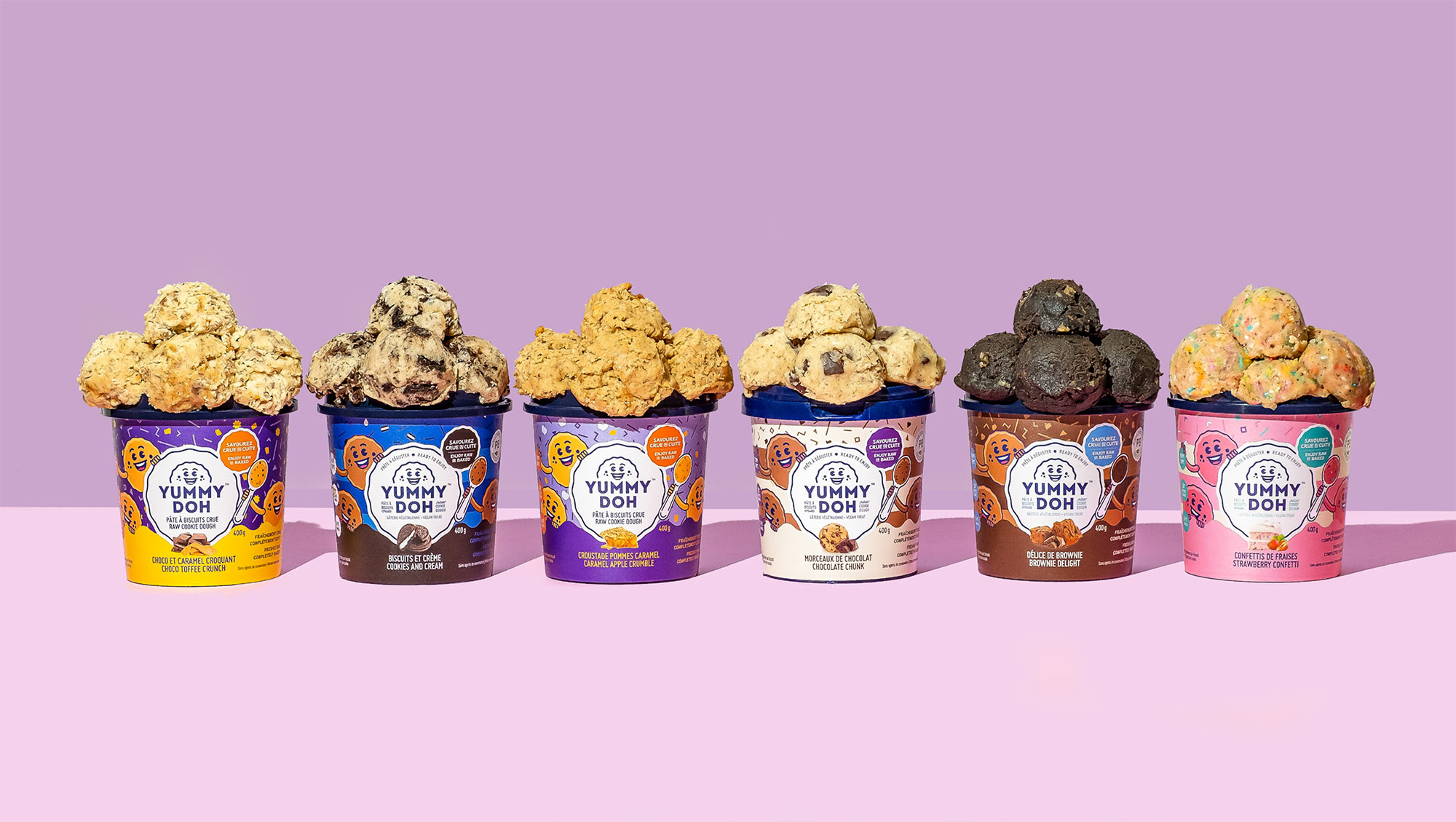
A packaging almost never exists alone for very long.
Over time, a brand often develops:
A design thought solely for a single product can quickly become difficult to adapt. This then creates visual inconsistency and complicates production.
Thinking in systems from the start allows for building a packaging identity that is more flexible, consistent, and effective in the long term.
Packaging does not live in a perfect environment.
In-store, it must work under different lightings, surrounded by many competitors, and sometimes poorly positioned on a shelf.
What seems effective on screen or in a presentation can lose much impact in a real situation. That is why it is essential to test the packaging directly in a grocery store context.
Readability, impact, and understanding must remain effective even in a busy and imperfect environment.
Food packaging must not only be aesthetic.
It must also: attract, inform, reassure, and support the purchase decision.
The most effective designs are often those that succeed in balancing creativity, clarity, and commercial performance.
Beautiful packaging catches the eye. Good packaging truly helps the product sell.
In grocery stores, packaging is often the first contact between a product and the consumer. Its ability to attract attention, clarify the offer, and create an emotional connection directly influences perception and sales.
At Design Grafico, we support companies in Montreal and Canada in creating strategic, consistent packaging designed to perform in real environments. Because good packaging doesn’t just serve to be noticed: it must make people want to be chosen.
Your packaging is much more than just a wrapper.